
Diversification beyond sovereign debt in an era of geopolitical risk
Financial markets have absorbed repeated geopolitical shocks with little lasting damage, yet this resilience does not imply a reduction in underlying vulnerability. The weakening of sovereign debt as a safe haven necessitates a reconsideration of how portfolios are diversified.
Abstract: The normalization of risk, economic adaptation, and public and private buffers moderate the initial impact of geopolitical shocks on earnings and valuations. These mechanisms, however, consume resources and may shift costs towards inflation and public finances, leaving markets more exposed to certain extreme shocks. In parallel, the shift in the inflationary regime has weakened the stabilizing role of sovereign debt, with the proportion of months in which equities and bonds lose simultaneously rising from 11% in 2006–2021 to 31% since 2022. The increased supply of sovereign debt, a more price-sensitive marginal buyer and the growing role of leveraged intermediaries in debt markets further reduce the reliability of bonds as a haven. Bonds nonetheless retain their protective value against disinflationary recessions, so their hedging capacity is conditional on the nature of the shock. Empirical analysis of 60/40 and 60/20/20 portfolios during various episodes of stress shows that diversification depends on whether the shock affects growth, inflation or fiscal confidence, with the 60/20/20 portfolio returning 8.5% annually since 2022 against 5.9% for the 60/40. These results are ex post and partly reliant on gold, and they favour scenario-based diversification over the extrapolation of historical correlations.
Introduction
Financial markets have shown remarkable resilience in the face of shocks which, given their intensity, could have triggered severe corrections. Ukraine, the rise in protectionism, the conflict in the Middle East and fiscal tensions have heightened geopolitical uncertainty without causing, apart from isolated episodes, a persistent deterioration in financial conditions. Stock markets have quickly recovered their losses, and volatility has returned to normal. At the same time, sovereign debt has lost some of its traditional ability to protect portfolios.
We believe that these two phenomena are linked. The markets’ greater tolerance reflects genuine adaptive mechanisms, but also a normalization of risk and a shift in the costs of shocks across market participants and over time. Part of this resilience is funded by public and private resources that are not unlimited. At the same time, inflation, the abundance of debt and changes in debt intermediation are shaping the stabilizing role of bonds. The system is better able to absorb more frequent shocks yet remains more exposed to certain extreme shocks.
Markets have raised their reaction threshold, but they are not immune
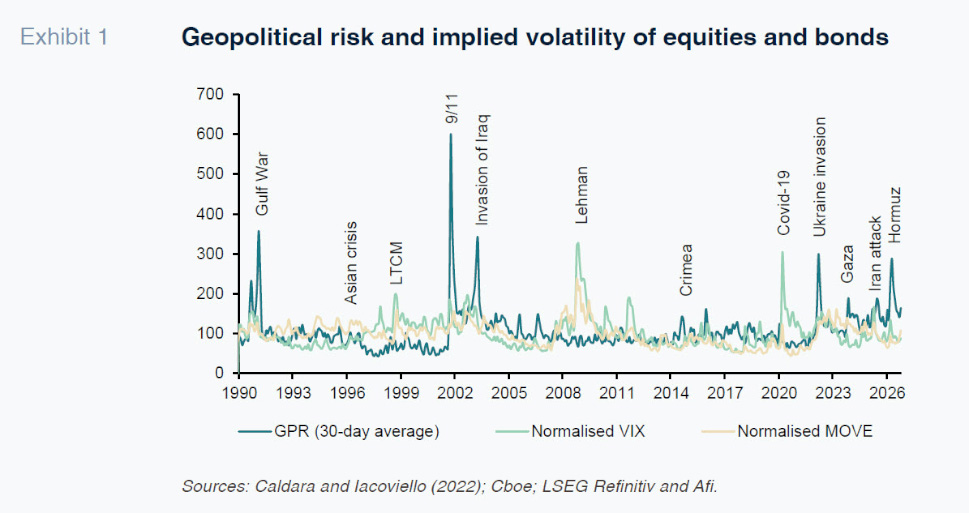
One manifestation of the new environment is the divergence between geopolitical risk and financial volatility. Since 2022, the Caldara and Iacoviello index has recorded successive spikes, whilst the VIX and MOVE have responded in a muted or temporary manner.
Such a comparison calls for caution: the former captures geopolitical threats and events; the latter reflect expectations of equity and bond volatility over relatively short time horizons. For financial prices, what matters most is whether an event alters expected cash flows, the discount rate or risk premiums. A conflict may be politically serious without affecting valuations if its economic effects prove to be limited.
Nevertheless, we believe that the reaction threshold has risen. The recurrence of threats and crises has introduced a greater degree of instability into the baseline scenario. The adjustment of expectations may be rational: investors distinguish between geopolitical news and shocks capable of altering fundamentals. Risk arises when this experience leads to extrapolating the rapid reversal seen in previous episodes and to underestimating persistent changes in inflation, economic activity or financial conditions.
Part of the calm in stock market indices may also be due to a composition effect. Their volatility depends both on that of their components and on the correlation between them. When sectors that benefit from and are adversely affected by the same shock react in opposite directions, the dispersion of returns increases without necessarily increasing aggregate volatility. A recent analysis finds negative three-month correlations in around 40% of stock pairs amongst the top 100 companies in the S&P 500 and 30% in the Euro Stoxx 50 (Agbo-Bloua, 2026). If a common shock resynchronizes the movements of the various assets, the index’s volatility may spike sharply. Apparent aggregate resilience may, therefore, coexist with intense adjustments beneath the surface.
There is, moreover, genuine economic adaptation. In the wake of the Ukraine crisis, Europe diversified its energy supplies and logistics routes; companies bolstered their inventories, hedging and alternative suppliers. These measures reduce the initial spillover of disruptions to production and profits. But resilience comes at a price: doubling capacity, stockpiling more or relocating production trades efficiency for security, raises fixed costs and may reduce potential growth or prolong inflation.
Financial and public buffers complete the picture. Relatively sound corporate balance sheets, strategic reserves and fiscal measures have prevented numerous shocks from turning into crises. However, absorbing the cost is not the same as eliminating it: public aid shifts part of the bill onto debt; price increases preserve margins but erode real income and demand. Each intervention may reduce the scope for response to the next episode.
The situation in Hormuz in 2026 illustrates this mechanism. Inventories, supply substitution and public support initially mitigated the impact on energy markets. Its protracted nature, however, has shifted pressure onto logistics, refined products, business costs and inflation expectations. The transmission becomes more dangerous when both valuation channels are triggered simultaneously: lower expected profits and higher discount rates. A supply shock can then simultaneously harm both the stock market and the bond market, without the monetary authority having its usual scope to offset it.
Duration and simultaneity also matter. Energy, trade and fiscal tensions may compete for the same reserves, budgets and response capacities. A disturbance that is manageable in isolation can cause disproportionate effects if it coincides with others and encounters eroded buffers. This dependence on the state of the system helps to explain why volatility can remain low until a certain threshold is crossed. The result is conditional resilience, in which the economy absorbs more noise — often at the expense of resources and efficiency —whilst risks of a discontinuous adjustment persist. Low volatility does not in itself indicate complacency, but neither does it guarantee that extreme shocks are correctly priced.
Sovereign debt: From shock absorber to potential source of instability
For much of the first two decades of the century, high-quality sovereign debt stabilized investment portfolios. Major shocks were essentially disinflationary: as economic activity fell, central banks cut interest rates, bond yields fell and bond prices rose. This negative correlation with the stock market made government debt the dominant hedge. Since 2021–2022, the greater weight of inflationary shocks has weakened this mechanism. A supply-side shock can reduce economic activity and raise prices at the same time: it undermines corporate profits and forces interest rates to remain high. Shares and bonds may fall simultaneously, precisely when diversification is most needed.
Added to this change in the nature of shocks is another structural shift in sovereign financing. Persistent deficits and spending requirements relating to an ageing population, defense and economic security are driving high levels of debt issuance. The balance sheet normalization by central banks is returning debt to the market, whilst the energy sector, infrastructure and artificial intelligence are competing for available savings. This does not automatically imply a shortage of buyers, but it does suggest a higher return is required to absorb a growing volume of safe assets. There is also a link to the first part: some policies designed to cushion shocks — such as subsidies, reserves and the duplication of capacity — also put pressure on budgets and potentially make future financing more expensive.
The marginal buyer is also changing. The relatively reduced presence of central banks and official investors gives greater weight to price-sensitive funds and private investors. Recent US Treasury auctions show demand capable of recovering when yields rise, albeit selectively across maturities. The problem is not necessarily placing the debt, but the cost required to do so. In conditions of abundant supply, this adjustment can increase the term premium and reinforce the transmission of shocks to the real economy.
Intermediation adds a second channel of vulnerability. Hedge funds link spot bonds, futures and repos, providing arbitrage and liquidity under normal circumstances. However, their strategies may rely on leverage and short-term funding; consequently, if margins or balance sheet constraints tighten, the simultaneous closing of positions amplifies price movements and reduces liquidity just when it is needed most. The performance of French debt in early October 2026 illustrates how a political and fiscal deterioration can interact with these mechanisms, without demonstrating widespread systemic fragility.
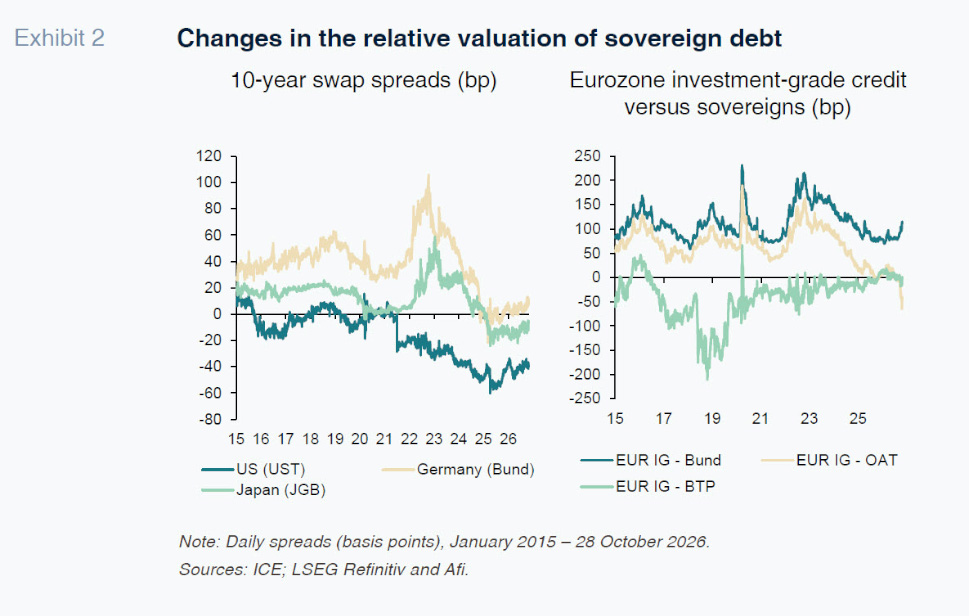
At the same time, part of the convenience premium is being eroded; that is, the lower return historically accepted for the liquidity, security and utility of sovereign debt as collateral. The trend in spreads relative to swaps and high-quality credit is consistent with this relative reduction in scarcity, although it also reflects technical factors relating to intermediation and financing. It is important to distinguish between the structural repricing of the bond and temporary liquidity dislocations: they stem from different causes but can reinforce one another.
The macroeconomic implications are significant. Higher sovereign spreads gradually increase the cost of refinancing, worsen the fiscal outlook and may necessitate further spreads, creating a feedback loop. If the shock is inflationary in origin, monetary policy has less scope to act as a counterweight. Thus, debt-financed resilience may ultimately reduce the capacity to respond to new crises.
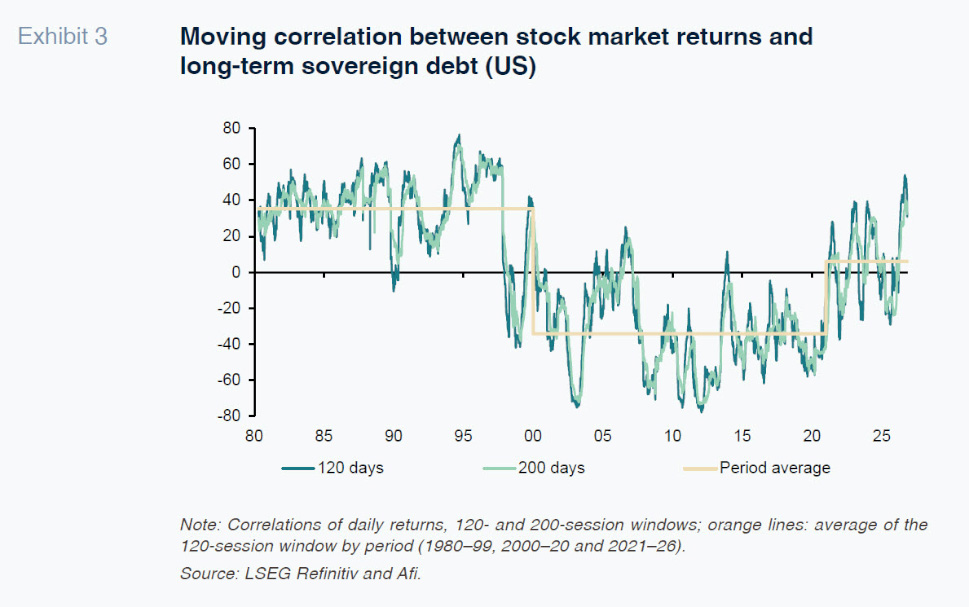
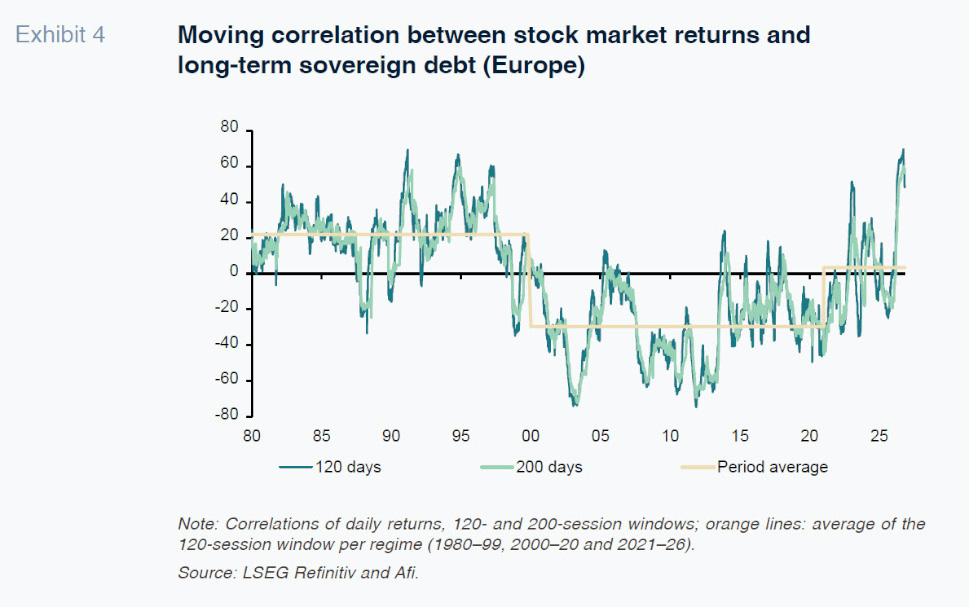
Market evidence is consistent with a regime shift: in the United States, the stock-bond correlation was predominantly positive in 1980–1999, negative in 2000–2020 and has frequently returned to positive territory since 2021. In the global euro-denominated sample, the proportion of months with simultaneous losses in equities and bonds rose from 11% in 2006–2021 to 31% since 2022. This does not mean that sovereign debt is no longer safe, nor that all issuers are equivalent. Its hedging effect is conditional: it retains value against deflationary recessions but may pass on additional losses in the event of inflationary shocks, fiscal mistrust or liquidity strains, particularly at longer maturities.
Diversify on the basis of shocks, not historical correlations
There is an economic explanation for the change in the sign of the correlation. When negative growth surprises predominate, the stock market tends to fall and bonds benefit from expectations of monetary easing. If inflationary surprises dominate, both assets may lose value due to higher discount rates; furthermore, lower profits may exacerbate the stock market decline. Therefore, diversification depends on the origin of the shock and the central banks’ response, not on a supposedly stable historical correlation.
To illustrate this, we compare two global portfolios denominated in euros since 2006: a 60/40 allocation to developed-market equities and debt, and a 60/20/20 allocation that retains 60% in equities, allocates 20% to developed-market debt, and distributes the remaining 20% across emerging-market debt, gold and commodities excluding precious metals. Both are rebalanced annually, and the analysis incorporates transaction costs of 10 basis points.
Between 2006 and 2026, the diversified portfolio yielded 7.2% annually compared with 6.5% for the traditional portfolio, with slightly higher volatility (8.6% versus 8.0%). Prior to 2022, the 60/40 portfolio offered better risk-adjusted returns. Since then, the 60/20/20 portfolio has achieved an annual return of 8.5% compared with 5.9 %, with virtually identical levels of volatility (9.2% and 9.3%) and a lower maximum drawdown (-9.1% and -11.0%).
These episodes illustrate the contrast. In 2008 and during the initial shock of the COVID-19 pandemic, the 60/40 portfolio fell less than the diversified portfolio (-26.6% compared with -29.4 %, and -11.3% compared with -13.8 %). Developed-market debt helped to protect the portfolios, although in 2008 gold performed even better (+35.7%). In 2022, the opposite occurred: the 60/20/20 portfolio lost 9.6 %, compared with 13.6% for the traditional portfolio, supported by commodities (+27.0%) and gold (+6.0 %).
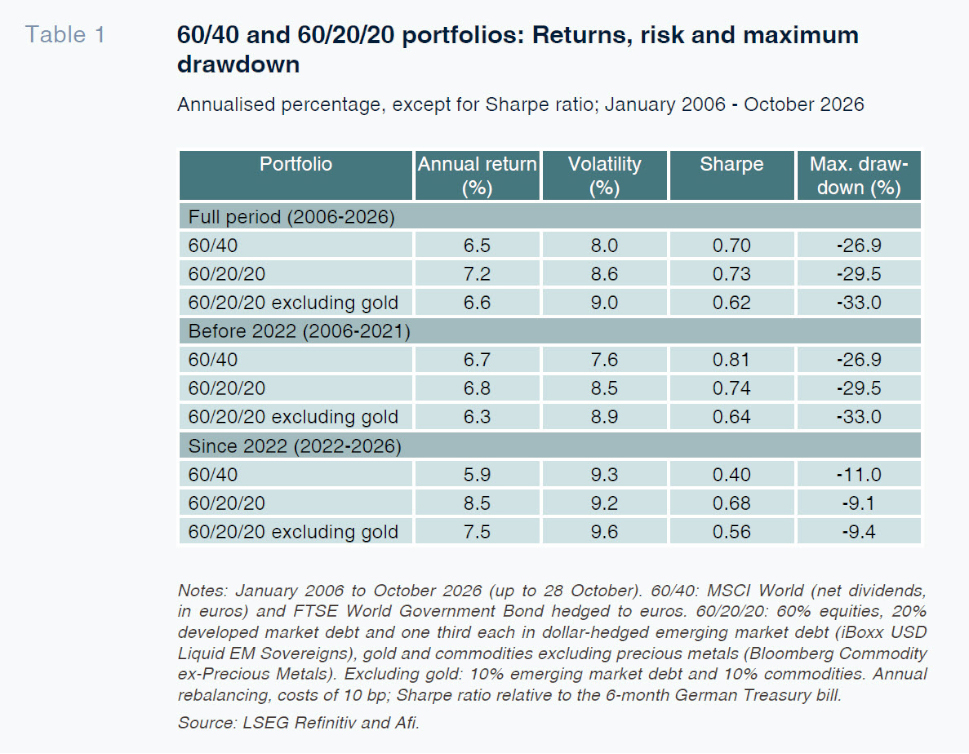
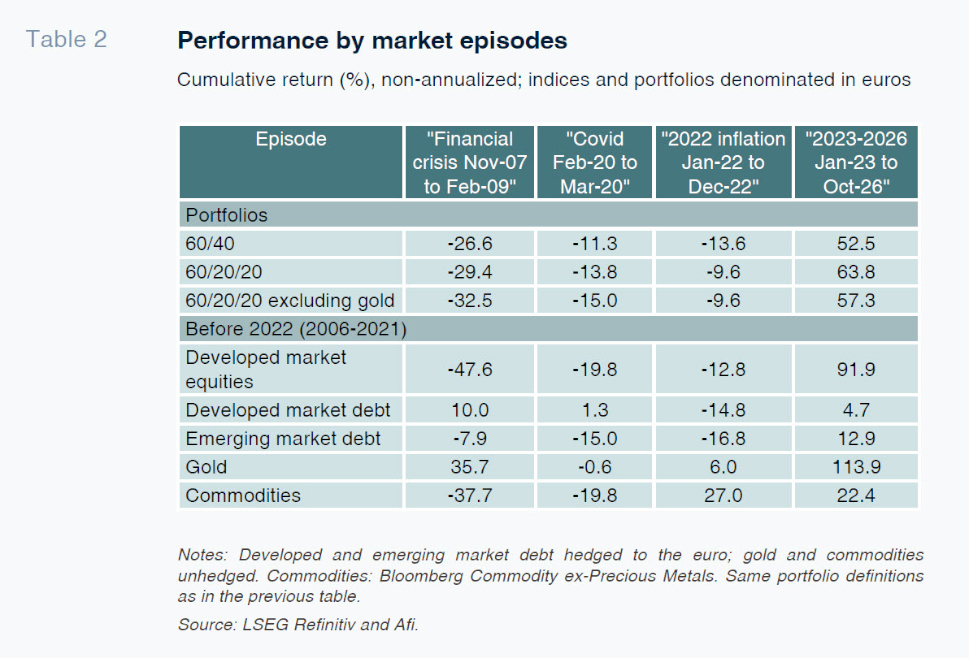
This does not imply that one portfolio is universally superior. Gold has contributed significantly to the recent performance, and its appreciation should not be extrapolated. Without gold, the advantage over the entire period almost disappears (6.6% compared with 6.5%), although it remains from 2022 onwards (7.5% compared with 5.9%). Emerging-market debt is also not a safe haven equivalent to that of developed markets: its credit and liquidity risks increase during global crises. Furthermore, the efficient frontier analysis shown in Exhibit 5 is ex post, not a recommendation for weightings.
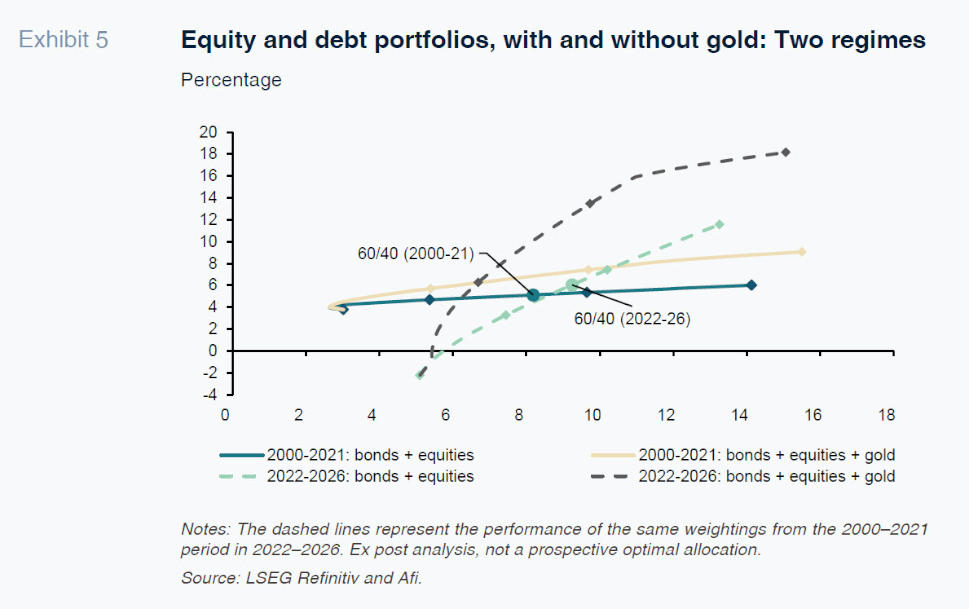
The evidence suggests diversifying according to scenarios, rather than mechanically replacing the 60/40 rule with another fixed rule. Sovereign duration provides protection against disinflationary recessions; commodities may respond better to supply shocks; gold may cushion losses of confidence in monetary or fiscal policy, although it entails volatility and valuation risk. The optimal allocation will depend on the set of shocks considered, their probability and their interactions. With changing correlations, scenario analyses and stress tests should complement —and at times take precedence over— the extrapolation of historical covariances.
Conclusion
The recent resilience of the markets does not imply a general reduction in financial vulnerability. Companies and governments have improved their ability to adapt, but at an economic and budgetary cost. If a prolonged shock simultaneously alters profits, inflation expectations and discount rates, prices may adjust much more sharply than they did in response to the initial manifestations of the shock.
Sovereign debt accentuates this asymmetry. Higher issuance volumes, more price-sensitive demand and intermediation whose liquidity may be conditional reduce its capacity to stabilize portfolios in the face of certain shocks. It remains a haven against disinflationary recessions, but not necessarily against inflation or fiscal deterioration.
Monitoring should focus on the persistence of supply shocks, inflation expectations, term premiums, sovereign liquidity and the stock-bond correlation. Regaining fiscal space and preserving monetary credibility is, moreover, a way of rebuilding responsiveness.
Ultimately, the markets have learnt to tolerate greater geopolitical instability, but they have fewer universal safeguards. The crucial question is how much leeway they retain to absorb the next shock and whether its effects will simultaneously impact growth, inflation and financial conditions.
References
AGBO-BLOUA, K. (3 November 2026). The risk of higher volatility in shares is rising. Financial Times.
AQUILINA, M., SCHRIMPF, A., SUSHKO, V. and XIA, D. (2024). Negative interest rate swap spreads signal pressure in government debt absorption. BIS Quarterly Review, December.
BIAŁKOWSKI, J., DANG, H. D. and WEI, X. (2022). High policy uncertainty and low implied market volatility: An academic puzzle? Journal of Financial Economics, 143(3), 1185–1208.
BIS. (2023). The correlation of equity and bond returns. BIS Quarterly Review, December.
BIS. (2026a). Markets recalibrate amid shifting currents. BIS Quarterly Review, March.
BIS. (2026b). High public debt and shifting financial markets: challenges for central banks. Annual Economic Report, Chapter II.
BRUNNERMEIER, M. K. and SANNIKOV, Y. (2014). A macroeconomic model with a financial sector. American Economic Review, 104(2), 379–421.
CALDARA, D. and IACOVIELLO, M. (2022). Measuring geopolitical risk. American Economic Review, 112(4), 1194–1225.
EREN, E., SCHRIMPF, A. and XIA, D. (2023). The demand for government debt. BIS Working Papers, 1105.
EUROPEAN CENTRAL BANK. (2025). What safe haven after the April US tariff announcement? Implications for euro area financial stability. Financial Stability Review, November.
INTERNATIONAL MONETARY FUND. (2025). Geopolitical risks: implications for asset prices and financial stability. Global Financial Stability Report, April, Chapter 2.
KRISHNAMURTHY, A. and VISSING-JORGENSEN, A. (2012). The aggregate demand for Treasury debt. Journal of Political Economy, 120(2), 233–267.
MOLENAAR, R., SÉNÉCHAL, E., SWINKELS, L. and WANG, Z. (2024). Empirical evidence on the stock-bond correlation. Financial Analysts Journal, 80(3), 17–36.
PÁSTOR, Ľ. and VERONESI, P. (2013). Political uncertainty and risk premia. Journal of Financial Economics, 110(3), 520–545.
SCHNABEL, I. (2025). No longer convenient? Safe asset abundance and r*. BEAR Conference, Bank of England, 25 February.
TODOROV, K. and VILKOV, G. (2024). What could explain the recent drop in the VIX? BIS Quarterly Review, March.
José Manuel Amor and Adrián Fernández. Afi